
- Published on February 12, 2026
- Bishnu K.
In Australia, there are 10 levels of qualifications you can earn after finishing school. These levels are part of the Australian Qualification Framework (AQF), which sets the national standards for each qualification..
Levels of Qualifications
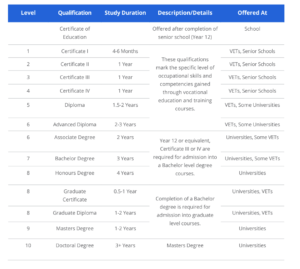
The AQF has 10 levels. Level 1 is the starting point for tertiary study, and Level 10 is the highest, representing a Doctorate degree.
The below table shows all 10 AQF levels and the types of schools or institutions where you can earn them.
Types of Qualifications
In Australia, qualifications are grouped into certificates, diplomas, and degrees.
Certificates
Certificate courses are offered in schools and Vocational Education and Training (VET) programs. They usually last from six months to two years and teach practical skills in areas like communication, math, and literacy.
There are four levels of certificates — Certificate I, II, III, and IV. Each level completed shows a higher set of skills. Certificate I is the starting level (AQF Level 1), and Certificate IV is the most advanced (AQF Level 4).
Diplomas
You can earn diplomas through Vocational Education and Training (VET) programs or some higher education institutions. There are three main types of diplomas:
Diploma:
Prepares students for jobs in industries or technical areas. These courses usually take about 18 months to two years of full-time study.
Advanced Diploma:
Builds higher-level practical skills for careers like accounting, building design, or engineering. Some advanced diplomas can be taken at university. They usually take two to three years of full-time study.
Graduate Certificate/Diploma:
Helps students develop advanced skills for work after completing a degree. A graduate certificate takes about six months to a year, while a graduate diploma takes one to two years of full-time study.
Some TAFEs partner with universities to offer Bachelor degrees, helping students gain skills and pathways beyond certificates and diplomas..
Degrees
Degrees are awarded by universities or other higher education institutions after completing an academic program. There are three main types of degrees:
Associate Degree (AQF Level 6):
Usually takes two years and provides broad knowledge for entry-level professional work or further study.
Bachelor Degrees (AQF Level 7):
The most common undergraduate degree, completed in about three years. A Honours Bachelor Degree (AQF Level 8) takes four years and includes a research component or specialization.
Master Degrees (AQF Level 9):
Taken after a bachelor degree for deeper study in a chosen field. They can be coursework-based (like an MBA) or research-focused and usually take one to two years.
Doctorate or PhD (AQF Level 10):
The highest level of study. These are research-based programs that create new knowledge in a field. Students generally need an Honours or Master degree and must find a research supervisor at their university.
Ready to Study in Australia?
👉 Are you still unsure about studying abroad or remaining in Nepal? For a free, one-on-one consultation, message Global Scholars Educational Consultancy right now. To help you make the best choice for you, we will provide you with frank guidance regarding nations, colleges, expenses, and employment prospects.